
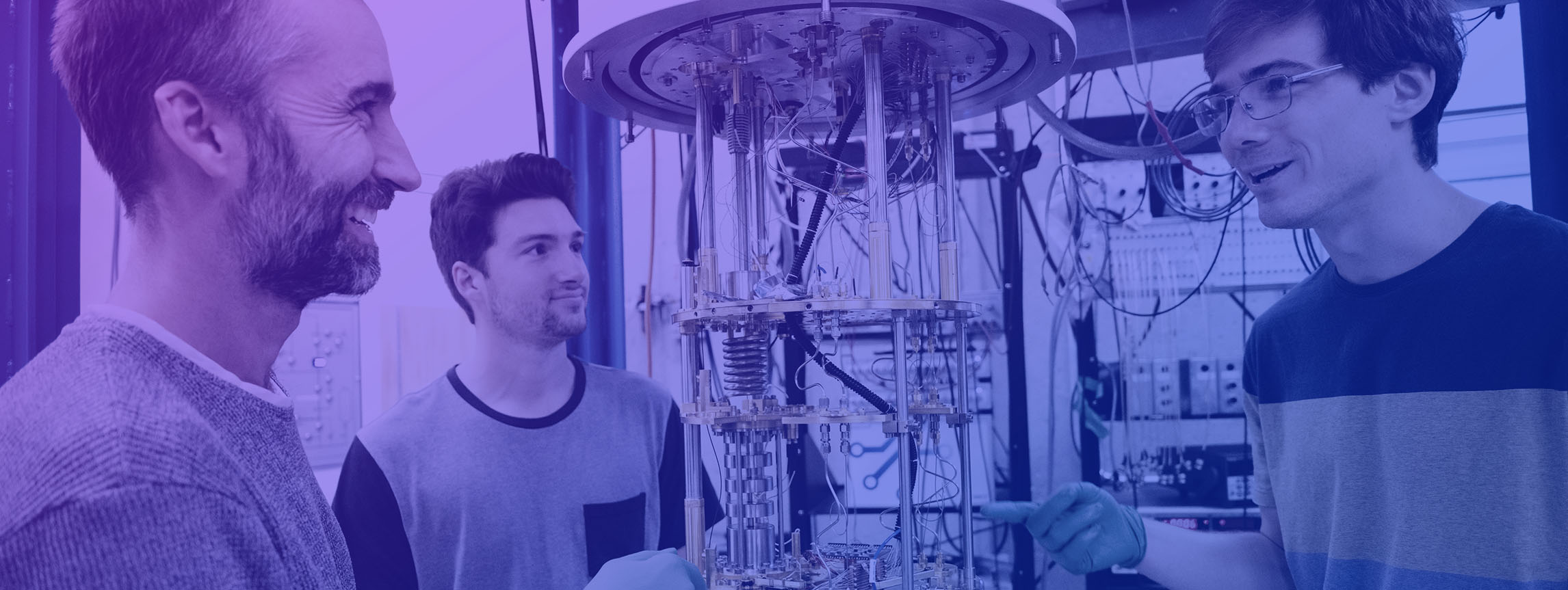
At the M1 Quantum Lab, we develop hybrid quantum systems designed to push the boundaries of current technologies. Our research spans several complementary areas, including microwave-optical transduction, optomechanics, superconducting qubits, quantum dots, and magnonic systems. By combining modeling, fabrication, and experimental characterization, we aim to advance the next generation of quantum architectures.
Quantum transduction
Quantum transduction seeks to transfer quantum information from one mode to another of a different nature. Our group focuses on microwave–optical transduction mediated by a magneto-optomechanical interaction, where information encoded in a microwave photon is transferred to an optical or telecom photon, or vice versa, through a mechanical system. This type of transduction is essential for distributed quantum computing, as it enables the entanglement of distant superconducting qubits and their interconnection through an optical network. These efforts pave the way toward the development of modular and distributed quantum processors. Our team works across the full development chain: design, modeling, optimization, fabrication, and characterization of devices, as well as software tools that enable the distribution of information and the quantum error correction at the network level.
Microwave-regime optomechanics for achieving single-photon strong coupling
Quantum optomechanics studies the controlled interaction between light and mechanical motion at scales where quantum effects become significant. The objective of this research is to reach the strong-coupling regime, in which a single photon can exchange energy reversibly with a mechanical oscillator. To achieve this, we investigate magnetomechanical coupling mechanisms to maximize the interaction between a superconducting microwave circuit and a mechanical system. We model, design, fabricate, and characterize high-quality mechanical structures and superconducting circuits. This work advances the understanding of light–matter interactions at the quantum scale and enables a wide range of applications, including precision metrology, inertial sensing, quantum transduction, and the preparation and control of quantum states in mechanical systems.
Quantum box
Semiconductor-based spin qubits represent a promising pathway toward quantum computing, offering several unique advantages for this architecture: scalable fabrication, co-integration with classical electronics, and direct coupling to optical photons for quantum communication.
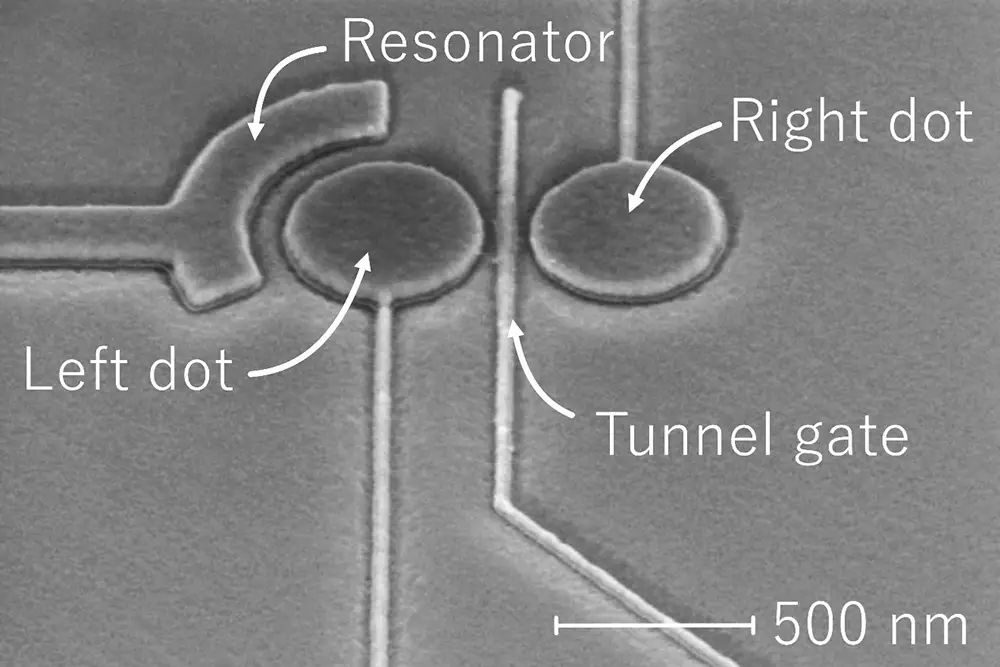
Our research focuses on this last aspect. We have demonstrated that it is possible to populate a quantum box by illuminating it with a laser whose frequency corresponds to the semiconductor bandgap energy. The occupation of the quantum box is then detected by coupling it to a superconducting coplanar resonator. The dispersive coupling between the two systems induces a measurable frequency shift of the resonator when an electron enters or leaves the quantum box.
This proof of concept paves the way for many research perspectives, including spin–photon transduction, scaling, the development of integrated optics devices, and compatibility with flip-chip architectures.
Fabrication of high-coherence transmon qubits
Hybrid quantum systems consist of heterogeneous physical systems that are combined to take advantage of their individual unique advantages. An example is the use of superconducting microwave resonators to mediate long-distance interaction between spin qubits realized in a semiconductor. The group has contributed to the first experiments showing the strong coupling between a single photon in a microwave resonator and a single spin in a semiconducting quantum dot, and to experiments demonstrating the coherent coupling of a semiconducting quantum dot to a superconducting qubit.
Collective effects between qubits
Qubits are the fundamental building blocks of quantum information. When they interact in a system such as a cavity or a waveguide, they do not behave simply as a sum of independent elements but as a whole, giving rise to collective effects. Our goal is to study these phenomena to understand how they could, in the long term, improve qubit coherence or enable faster operations.
One of the main challenges lies in the precise positioning of the qubits: spatial disorder strongly perturbs collective emission. However, it has been shown that these effects are more robust in a one-dimensional waveguide, which motivates us to compare different environments with levels of precision achievable in the laboratory. The systems we aim for are not yet realizable with current technologies, but the development of new fabrication techniques could make these architectures accessible.
Finally, we are also interested in the influence of temperature. Previous simulations suggest that some collective effects would vanish at very low temperatures. By comparing numerical simulations with concrete experiments, we hope to confirm or refine these results, and perhaps show that quantum collective phenomena remain observable at room temperature – a promising perspective for broader applications.
Magnonic
Magnons, the quanta of collective spin excitations, hold potential for quantum technology applications, but they are often difficult to integrate with other systems. Our research focuses on hybrid quantum systems bringing together magnons and microwave circuits, investigating off-resonant, nonlinear interactions inspired by optomechanics. The platform is built on microwave circuits using disordered superconductors, whose behaviours under magnetic fields are investigated in cryogenic conditions. With the right parameters, we hope to realize exotic coupling regimes to magnetic thin films fabricated on top of these circuits.